
The Adoption of Ethereum in Japan with Local Communities
Tomo, founder and CEO of Pheasant Network and PG Labs, speaks with Mo Jalil, APAC Enterprise Lead at the Ethereum Foundation, about Ethereum’s growing presence in Japan.
As someone originally from Japan, Tomo offers a local perspective on how the crypto scene has evolved, while Mo shares insights from the Foundation’s efforts to build stronger connections with Japanese enterprises and developer communities. Together, they explore how Ethereum is evolving in Japan, the challenges it faces, and the role collaboration plays in its future.
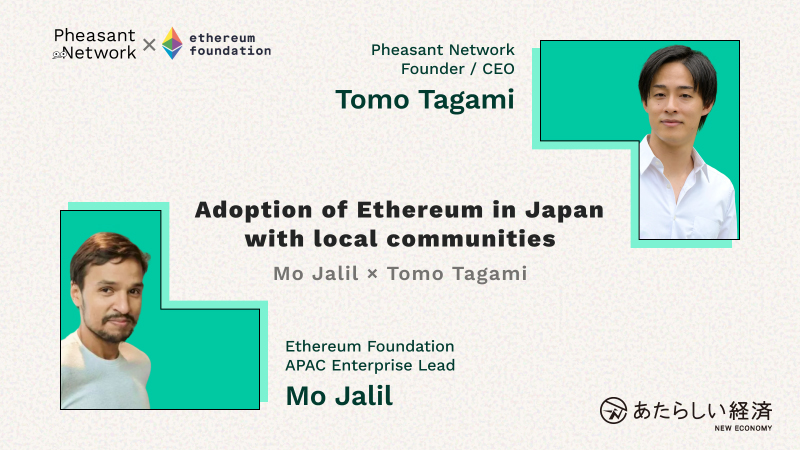
EF Mo Jalil × PG Labs Tomo
Tomo: I’m Tomo, founder and CEO of Pheasant Network and PG Labs. I’m excited to have this conversation with you because what I’ve been building aligns closely with what the Ethereum Foundation is doing.
Pheasant Network, which I started a few years ago, focuses on developing an AI-powered intent-centric interoperability protocol. While our goal is to make the broader blockchain ecosystem more seamless and connected, most of the networks we currently support are Ethereum-based. We were also the only project in the Layer 2 category to receive an Ethereum Foundation grant in Q3 2022. To show how deeply we’re involved in this space, we also created L2 Learn — probably the world’s only online learning platform dedicated to the Layer 2 domain.
My other company, PG Labs, is a Japan-based Web3 studio focused on creating public goods that people genuinely use and value. We’ve been involved in the design, planning, development, and marketing of several Web3 projects — including Pheasant Network and L2 Learn.
My connection to Ethereum actually goes back even further. Before those two projects, I founded a crypto initiative called Proof of Learning (PoL) and became the first Japanese recipient of the Eth2 Staking Community Grant in 2022.
So as a Japanese crypto entrepreneur, I’m genuinely excited to talk with the Ethereum Foundation’s APAC Enterprise Lead about the future of Ethereum here in Japan. Nice to meet you.
Mo:Nice to meet you too, Tomo.
1. Who I Am and the Vision Behind EF’s New EcoDev Cluster
Tomo:To start off, could you introduce yourself—your role at the Ethereum Foundation, and how you’re connected to the Japanese Ethereum and crypto communities?
Mo:I’m Mo Jalil, the APAC Enterprise Lead at the Ethereum Foundation, where I focus on institutional adoption and privacy infrastructure. I also co-lead the Institutional Privacy Task Force (IPTF) , a collaboration between EF’s Enterprise and Privacy & Scaling Explorations (PSE) teams.
I care about the Japanese ecosystem. I’ve spent significant time here working closely with local developers, researchers, and enterprise partners from hosting research residencies in Tokyo and collaborating with university groups, to supporting conversations with financial institutions exploring Ethereum-based pilots. Japan has one of the most thoughtful, technically sophisticated blockchain communities in the world, and EF sees it as a cornerstone for advancing privacy, security, and open-source innovation in Asia.
Tomo: It’s good to see someone from a major project like the Ethereum Foundation working directly with people in Japan. That kind of presence makes a big difference for the local ecosystem.
You mentioned that you co-lead the Institutional Privacy Task Force, which spans multiple domains. It reminded me that many people outside the Foundation don’t fully realize how broad its structure is — it’s not just one team but a network of layers and initiatives working in parallel.
On that note, I’d like to ask about something new within the EF — EcoDev. Could you tell me a little about it?
Mo: The Ecosystem Development (EcoDev) cluster is a new initiative inside the Ethereum Foundation designed to strengthen collaboration between the EF and the broader ecosystem. Our mission is to help developers, startups, and institutions translate Ethereum’s open-source technology into real-world applications.
Basically, EcoDev acts as a bridge between technical research, community engagement, and institutional collaboration.
Tomo: Without the ecosystem, Ethereum wouldn’t be what it is. I think many people would agree that a big part of why the Ethereum community has grown so large and diverse comes from the EF’s long-term commitment to putting developers and researchers first — and that kind of foundation can’t be built overnight.
I really like that whenever I go to an Ethereum event, big or small, whether it’s organised by the EF or a local community, I meet people who are philosophically and fundamentally aligned. It feels like we’re all moving toward the same vision. That kind of cohesion is rare, even in the crypto world, in my opinion.
Mo: Exactly. Developer events like Devcon or Devconnect play a crucial role in keeping that ecosystem connected. That’s why coordinating educational programs, hackathons, and workshops to grow regional developer communities is one of the main areas of focus for EcoDev. Beyond that, it also works to connect builders with the right EF teams and tools, and to catalyse long-term partnerships — from privacy-preserving finance to public-sector use cases that show Ethereum’s neutrality and reliability as global infrastructure.
As part of the ecosystem development effort, the Foundation actually plans to put even greater focus on Japan going forward.
2. What Makes the Japanese Ethereum Community Unique
Tomo: As someone who’s from Japan and has been in the Ethereum ecosystem since nearly the beginning of the project, I’m so happy and excited to hear that. I’d really like to get deep into this. First, I’d like to know how you see the Japanese crypto landscape. From your perspective, what makes the Japanese Ethereum community unique compared to other countries in Asia or beyond?
Mo: The Japanese community is deeply principled. Builders here tend to value security, correctness, and ethics as much as innovation and that’s rare. There’s also a remarkable blend of academic rigor and creative experimentation, whether it’s cryptography research, game-related use cases, or experiments with digital identity.
Compared to other regions, Japan’s Ethereum community is deliberate, thoughtful, but incredibly consistent. That stability is why Japan has produced many great researchers and technical contributors, and it’s also why global teams look to Japan as a reliable collaborator.
Tomo:I absolutely agree with you. I actually see a lot of similarities between Ethereum’s philosophy and what many Japanese people value. For example, the community-first principle aligns closely with our traditional idea of putting others before ourselves, with respect. There’s also a strong sense of craftsmanship and pride, which I often see reflected in many Ethereum developers. Personally, I think that spirit owes a lot to Aya Miyaguchi, who’s Japanese and the current President of the EF.
On the flip side, that same uniqueness can make it harder for people from other countries and cultures to enter or collaborate within Japan’s crypto community. We’ve built a system that can sustain itself — which is good — but that self-sufficiency can also create silos, gradually weakening our connection with the wider global ecosystem.
I’ve been in the Ethereum space for quite a while now, both personally and through different projects — some based in Japan and others global. And I still feel that Ethereum has a really strong presence around the world, especially across Asia. Japan has one of the biggest developer communities and markets in the region, and you can see how many other Asian countries and companies want to connect with it, yet often struggle to figure out how.
Japan is a unique country with a unique culture and language, and that will always be true. But despite that, I’d love to see it become a hub within the Ethereum and broader crypto ecosystem — and I believe the EF is in a position to help bridge that gap.
Mo: I share that view completely. Like I said, Japan has world-class researchers and enterprises, but these groups often operate in silos. I hope Ethereum can help by providing connective tissue: funding cross-disciplinary research, offering open technical specifications that enterprises can safely adopt, and creating spaces both physical and digital where Japanese builders can collaborate directly with global contributors. We’re also investing in education around privacy-preserving technologies.
Tomo: I’d like to bridge that gap through my own projects as well. Pheasant Network has been a good lens for seeing how unique the Japanese community really is. It started as a global project, and while I’m Japanese, I never branded it as a Japanese project — simply because it isn’t. As a result, it’s far better known outside Japan than within the country.
I want to share what I’ve learned through Pheasant with Japanese projects and founders so that, together, we can build a stronger global presence and reconnect more deeply with the wider ecosystem.
3. Unlocking Adoption in Japan and the Rise of the “Japan Working Group”
Tomo: Now, considering Japan’s uniqueness — both the strengths and the challenges — what do you think are the key factors driving Ethereum’s adoption here?
Mo: I’d say there are two main things driving it.
First is corporate experimentation. Major Japanese conglomerates, from finance to gaming, are exploring Ethereum-based use cases, often with a focus on compliance and privacy. Second is alignment with open standards like you mentioned. Japan’s engineering culture values open collaboration, transparency, and long-term reliability, which all resonate strongly with Ethereum’s core principles.
And as these forces converge, we’re seeing growing interest in areas like tokenized finance, on-chain IP, and verifiable credentials — all spaces where Ethereum’s ecosystem already leads.
Tomo: I think the emerging fields of asset tokenization and on-chain IP fit naturally with the Japanese market.
So far, we’ve talked about the current landscape of the Japanese community and Ethereum. Based on that, I’d like to look ahead and explore it in more concrete terms. Earlier, you mentioned that the EF plans to place greater focus on Japan going forward. What concrete steps or initiatives are being planned to strengthen Ethereum’s presence here?
Mo: We’re taking a multi-layered approach that builds on Japan’s existing strengths. Concretely, that means a few things. First, we’re forming a Japan Working Group. It’s a structured EF initiative to coordinate with local leaders, developers, researchers, and startups, and to ensure Japan has a consistent voice within the global Ethereum ecosystem.
Second, we’re deepening enterprise engagement, supporting dialogues with Japanese financial institutions, regulators, and corporations that are exploring tokenized assets, stablecoins, and privacy-preserving compliance frameworks.
And finally, there’s community empowerment. We plan to provide grants, open-source funding, and visibility to Japanese developer groups and local projects that contribute to Ethereum.
Tomo:That sounds very solid. I’m glad you brought up the dialogues with financial institutions and regulators. Japan is one of the most regulated countries in the world, and crypto — Ethereum included — can’t really thrive without open communication with governments, authorities, and regulators.
And about the community empowerment aspect — I really appreciate the EF’s grassroots, bottom-up, community-first approach to expanding Ethereum’s presence.
Mo: Yes, I believe grassroots is where Ethereum’s long-term health really lies, and that’s how we plan to deepen those ties in Japan. This points to a few concrete initiatives.
First, we’ll be running local workshops and student programs, hands-on sessions on ZK circuits, privacy-preserving smart contracts, and applied cryptography in collaboration with professors and student clubs.
There’s also a focus on community collaboration, empowering local organisers to run meetups under shared EF-supported frameworks.
Another part is contribution pathways, helping Japanese developers connect and collaborate directly with core contributors worldwide.
And finally, translations and accessibility, making sure technical materials, documentation, and event content are available in Japanese to lower the barrier to entry.
Essentially, the goal is for the EF to act as a collaborator and supporter, not a director.
Tomo: I really like the way you put that — the EF as a collaborator and supporter, not a director. That approach makes a lot of sense to me. It’s great to see the Foundation tapping into existing communities and helping them grow organically, rather than trying to lead or create new ones from scratch.
There are already so many amazing, enthusiastic circles within Japan’s Ethereum community — Ethereum Japan, the organiser of ETHTokyo; ZK Tokyo and Nyx Foundation, which research and host events ZK technology; and Base Japan, an active Layer 2 community, just to name a few.
I also started an online group for people participating in Devcon or Devconnect, and it already has around 150 members — honestly, even I was surprised by that number.
4. Where Japan Can Lead: Finance, Gaming & IP, Public Goods, and Digital Identity
Next, I’d like to shift our focus a little and ask about the Japanese market. Are there particular industries in Japan where you see the greatest potential for Ethereum adoption or collaboration? What makes those areas especially promising?
Mo: Yes, there are three sectors in particular that I’m paying close attention to.
The first is the financial services sector. Banks and asset managers are exploring tokenized bonds, stablecoins, and settlement systems.
Tomo: Stablecoins are definitely a hot topic in Japan’s fintech scene. I suppose you’ve heard of projects like JPYC.
Mo: Yes, absolutely. In this area, privacy-preserving standards, like those developed by IPTF, are key to making that viable on Ethereum.
The second is the gaming and creative IP industry. Japan’s world-class game studios and creators can leverage Ethereum for digital ownership, royalties, and interoperability across worlds.
Tomo: That’s one industry Japan can truly be proud of. I really believe that adoption in this area could catalyse broader mass adoption here — it’s such a big and influential sector.
Mo: It could, potentially.
And the third industry I’m curious about is the public sector and digital identity. With Japan’s national digital initiatives underway, Ethereum’s verifiable credential frameworks and attestation standards can underpin trusted, cross-border identity layers.
Tomo: A project called MynaWallet is making a lot of progress in that credential and authentication space. And like you said before, Japanese developers tend to value security, correctness, and ethics just as much as innovation — which are crucial traits when working on sensitive areas like privacy and digital identity.
In that sense, I really think Japan has the potential to lead globally in this domain. As a side note, a Japanese developer has been deeply involved in the development of ZK Email, a privacy-focused email technology, and as a Japanese crypto enthusiast, I feel quite proud of that.
5. How Japan’s Web3 Momentum Shapes the Global Landscape
Mo: It’s great to see Japanese developers making real progress and having such a strong influence on Ethereum and the broader crypto space. Japanese teams often contribute deeply to protocol security, cryptographic engineering, and governance thought-leadership, rather than short-term trends. As Ethereum continues evolving, especially around privacy, identity, and regulatory interoperability, Japan’s disciplined approach can shape how Ethereum scales responsibly for institutions and citizens alike.
Tomo: It’s so true that we value goods and technologies that stand the test of time rather than short-term trends. I believe that’s a perspective you can’t ignore if you want Ethereum to be adopted and established as a social infrastructure and public good beyond the crypto world.
In that sense, I think Ethereum’s wider adoption in Japan could accelerate its overall development. This long-term mindset — prioritising enduring value over short-term gain — could spread from Japan to the global Ethereum community. That’s why I’d love to see the EF continue to take strong initiatives here.
Mo: Yes, a stronger Japanese initiative also means more rigour, research, and reliability feeding into global standards, which ultimately benefits the entire Ethereum ecosystem.
Tomo: Precisely.
6. How to Get Involved: Advice for Japan’s Next Contributors
There are so many amazing, diligent Japanese developers, entrepreneurs, and community builders. For those who want to actively contribute to Ethereum, what kind of advice would you give them?
Mo: Start small, but start today.
Tomo: That’s a good one, and something a lot of people forget.
Mo: There are so many things you can do right now. You can join a local Ethereum community or meetup — these are great gateways into global networks.
Contributing to open-source repositories like those from the Ethereum Foundation, PSE, or client teams is also a good starting point. Even small documentation fixes matter. For example, we just open sourced our market map for IPTF (institutional privacy task force), and we would welcome contributions.
And some of the best learning happens through direct interaction with other contributors across borders, online communities and events like EthTokyo, so collaborate internationally.
Ethereum is built by people who show up and Japan already has an incredible base of thoughtful builders ready to make a global impact.
Tomo: True. Japan already has so many open, brilliant communities that welcome anyone — whether you’re a developer, businessperson, or complete newcomer. I’d also encourage Japanese Ethereum fans to see themselves as part of the ecosystem and just start doing something for the community without overthinking it.
Mo, thanks so much for this deep and inspiring conversation. I’m honestly excited to have more opportunities to work with you in the future to help grow Ethereum adoption in Japan.
Mo: Thank you, too.